


Views: 0 Author: Site Editor Publish Time: 2026-09-03 Origin: Site


Meta Description: Learn how to keep barber capes static-free and reduce hair cling during professional services. Compare fabrics, anti-static treatments, cleaning methods, and buying options for professional and custom barber capes.
Static electricity can be a surprisingly frustrating problem in barber shops and salons. When a cape becomes highly charged, cut hair can cling to the fabric instead of falling naturally to the floor. This can make cleanup more difficult and reduce the client's comfort.
So, how do you keep barber capes static-free?
The most effective approach is to combine the right fabric, appropriate anti-static treatment, proper cleaning, humidity control, and suitable cape construction.
For professional businesses, choosing a cape designed with anti-static performance from the beginning is usually more reliable than trying to solve static problems after purchase.
Whether you use custom barber capes, professional barber capes, barber capes for hair cutting, or barber capes for hair styling, static control should be considered as part of the overall product design.
Quick Answer
To reduce static electricity on barber capes:
Choose fabrics with anti-static properties.
Consider an anti-static fabric treatment.
Avoid excessive heat during drying.
Use appropriate laundry products.
Maintain reasonable salon humidity.
Remove loose hair regularly.
Select a cape specifically designed for professional hair cutting.
Test fabric performance before placing a large B2B order.
For high-volume professional use, fabric selection is usually more important than temporary anti-static sprays.
Static electricity occurs when electrical charges accumulate on the surface of a material.
Synthetic fabrics such as nylon and polyester can develop static under certain conditions, particularly when the environment is:
Dry
Low humidity
Cold
Subject to friction
Hair rubbing against the cape can then cause loose strands to cling to the fabric.
This is particularly noticeable with barber capes for hair cutting, where large amounts of short, lightweight hair are generated.
Static may seem like a minor issue, but it can influence the entire service workflow.
Instead of falling away from the client, cut hair can remain attached to the fabric.
More hair remaining on the cape can increase brushing, shaking, and cleaning time.
Hair trapped around the neckline or inside the cape can become irritating.
For busy barbershops, small cleaning delays can accumulate throughout the working day.
Therefore, static control is not simply a fabric preference—it can contribute to client comfort and operational efficiency.
Material selection is one of the most important factors.
Material / Feature | Static Control | Hair Release | Typical Application |
Standard Nylon | Moderate | Moderate | General cutting |
Crinkle Nylon | Good potential | Good | Professional cutting |
Polyester | Moderate | Moderate | Styling |
Microfiber Polyester | Depends on treatment | Depends on construction | Kids' services |
Anti-Static Fabric | Excellent potential | Better | Professional barbering |
Treated Synthetic Fabric | Excellent potential | Better | Premium capes |
Neoprene Collar + Treated Body | Depends on outer fabric | Depends on body fabric | Premium barber capes |
There is no universal “static-free” fabric. Performance depends on fiber type, fabric construction, finishing, environmental conditions, and treatment.
Crinkle nylon is commonly used in professional salon apparel because its textured surface can help reduce the tendency of cut hair to remain tightly attached compared with some very smooth fabric surfaces.
However, fabric texture alone does not guarantee anti-static performance.
For professional barber capes, manufacturers should consider:
Fabric construction
Surface finish
Anti-static treatment
Humidity
Washing performance
Hair release after repeated use
This is why product testing is important when developing custom barber capes.
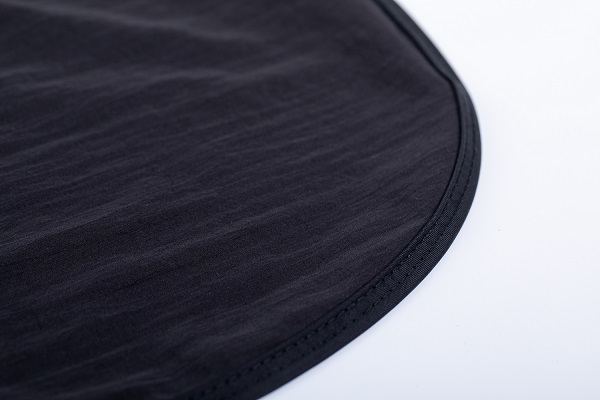
A dedicated anti-static treatment is incorporated into the material or finishing process.
Advantages:
Designed into the product
More consistent than temporary sprays
Suitable for professional products
Can be evaluated during product development
Consideration: Performance should be tested after repeated washing.
An anti-static spray can provide temporary assistance.
Advantages:
Convenient
Quick to apply
Useful for immediate problems
Limitations:
Temporary effect
Requires repeated application
May not be suitable for every fabric or salon environment
For B2B products, a properly engineered fabric solution is generally preferable.
Incorrect laundry practices can contribute to static.
High-temperature drying can increase static in some synthetic fabrics.
Use the manufacturer's recommended drying method.
Over-drying can increase static buildup.
Follow the manufacturer's care instructions rather than assuming that stronger detergent provides better cleaning.
Snaps, Velcro, or hooks should be secured appropriately before washing to reduce unnecessary mechanical stress.
Dry air can make static more noticeable.
During winter or in naturally dry environments, maintaining a more comfortable indoor humidity level may help reduce static buildup.
This is particularly relevant for barbershops using large numbers of synthetic hair cutting capes throughout the day.
However, humidity control should be viewed as a supporting measure—not a replacement for appropriate fabric selection.
Barbers frequently perform short cuts using clippers and scissors.
Their priorities may include:
Reduced hair cling
Fast cleanup
Lightweight construction
Comfortable neck closure
Durability
Easy maintenance
For professional barber capes for barber services, anti-static performance can therefore contribute directly to workflow efficiency.
Salons may use capes for:
Hair cutting
Styling
Blow drying
Finishing
For barber capes for hair styling, water and styling-product resistance may be important alongside static control.
Neoprene barber capes are often selected for their comfortable, close-fitting neckline.
A neoprene collar can help create a secure barrier around the client's neck, but it should not automatically be considered an anti-static solution.
For the best neoprene barber cape , evaluate the complete product:
Outer fabric
Anti-static performance
Collar comfort
Closure
Stitching
Washing performance
In other words, the neoprene collar and the cape body should be evaluated separately.
Static can be especially noticeable with children's haircuts because loose hair can easily stick to clothing and skin.
A barber salon cape for kids should ideally combine:
Lightweight construction
Comfortable neckline
Appropriate coverage
Easy cleaning
Suitable anti-static performance
Durable closure
Child-friendly design
For children's products, comfort should remain a priority rather than focusing solely on static control.
If you are purchasing custom barber capes for a salon chain, distributor, or private-label brand, ask the manufacturer specific questions.
Does the fabric have anti-static properties?
Is an anti-static treatment available?
How does the fabric perform after washing?
Does the surface encourage hair release?
Is the neckline reinforced?
What closure is used?
Is the cape lightweight?
Are the seams designed for repeated use?
Request samples and evaluate:
Hair Cutting → Hair Accumulation → Hair Release → Washing → Drying → Repeat
This real-use test provides more useful information than judging fabric performance by appearance alone.
Before purchasing, check:
Anti-static fabric or treatment
Good hair-release performance
Lightweight construction
Comfortable neckline
Reliable closure
Easy-care fabric
Suitable washing instructions
Durable stitching
Consistent production quality
Sample testing completed
For large B2B orders, testing the actual production sample before bulk manufacturing is strongly recommended.
Static electricity, fabric surface characteristics, friction, and dry air can all contribute to hair cling.
Fabrics with appropriate anti-static properties or treatments are generally preferable. Crinkle nylon and treated synthetic fabrics can be practical options, but actual performance should be tested.
Not necessarily. Polyester can develop static under certain environmental conditions. Anti-static treatment and fabric construction can improve performance.
A suitable anti-static spray may provide temporary assistance, but check compatibility with the fabric and any coating or finish first.
Not automatically. Static performance depends primarily on the cape's materials, construction, treatment, and environment.
Maintain comfortable indoor humidity, avoid excessive drying heat, follow proper laundry procedures, and choose fabrics designed for improved anti-static performance.
Yes. B2B manufacturers can develop custom barber capes using suitable fabrics and finishing treatments according to the required application and specifications.
Keeping barber capes static-free is not about finding a single magic product. It is a combination of fabric engineering, finishing, laundry care, environmental control, and appropriate product design.
For professional use, the best strategy is:
Right Fabric → Anti-Static Performance → Correct Care → Controlled Environment → Real-Use Testing
For barbers, this can mean less hair cling and faster cleanup. For salon clients, it can improve comfort. For B2B buyers, it can mean a more functional product with stronger long-term value.
For professional barbershops and B2B buyers, reducing static starts with selecting the right fabric and finish, then validating performance through real-use and wash testing.


