


Views: 0 Author: Site Editor Publish Time: 2026-10-26 Origin: Site


Transitioning from generic salon apparel to a private-label program requires moving from passive purchasing to active product specification. You cannot simply pull off-the-shelf garments and expect them to convey premium quality. Instead, you must dictate every design detail yourself. Client expectations have fundamentally shifted across the beauty industry. Luxury touchpoints and cohesive brand identity are now baseline requirements for high-ticket salons. When someone slips into a garment before a service, they instantly judge your professionalism and attention to detail.
To successfully manufacture custom salon client robes, buyers must translate aesthetic goals into strict technical requirements for factory partners. We will show you exactly how to build a robust technical pack. You will learn to control fit, fabric, and branding to launch a flawless apparel program. By mastering these procurement steps, you avoid costly manufacturing mistakes and elevate your daily client experience.
Brand Cohesion: Private-label salon robes transform a basic utility into a measurable brand touchpoint.
Technical Specs Matter: Success depends on defining precise OEM salon client robe specifications, including fabric weight, chemical resistance, and closure types.
Supply Chain Reality: Balancing Minimum Order Quantities (MOQs) with quality control requires a structured sampling and wash-testing phase.
Risk Mitigation: Specifying bleach-resistant, colorfast materials prevents premature inventory turnover and protects ROI.
Generic robes dilute brand identity. They often fail to meet specific chemical demands. High-volume salons require garments built for heavy, daily use. Off-the-shelf options usually feature cheap materials. They stain easily when exposed to hair color or bleach. They degrade quickly under industrial washing cycles. You lose money constantly replacing ruined inventory.
Developing private-label salon robes solves these exact problems. It fundamentally changes how you manage your salon inventory. From a perceived value standpoint, a branded, high-quality garment acts as a luxury touchpoint. It elevates the overall client experience. Premium service pricing requires premium physical touchpoints. When a client feels comfortable and sees your logo flawlessly integrated, they trust your expertise.
Direct-to-factory sourcing also improves your unit economics. You skip domestic markup fees. Tightly controlling the manufacturing quality directly reduces long-term replacement costs. A successful rollout achieves 100% brand alignment across all franchise locations. It standardizes client comfort. Most importantly, it slashes annual replacement rates by keeping durable, chemical-resistant garments in circulation longer.
Common Business Case Pitfalls:
Failing to calculate the annual replacement cost of generic robes before sourcing custom ones.
Ignoring the physical client experience when setting premium service pricing.
Assuming factory-direct sourcing is too complex without researching OEM partners.
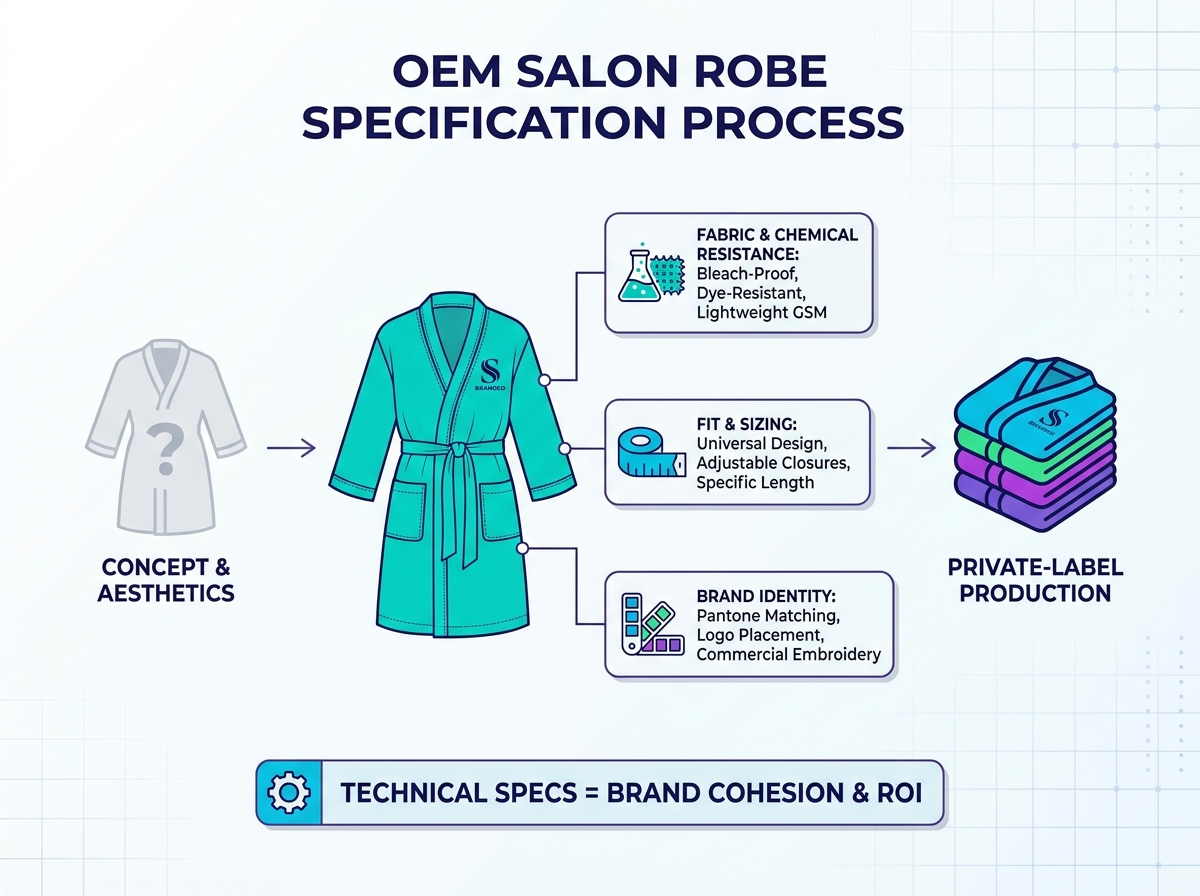
Building a concrete technical checklist ensures supplier capabilities match your needs. You must provide highly detailed OEM salon client robe specifications to your factory. Vague descriptions lead to poor production runs. You must dictate fabric, fit, and construction standards.
Material selection makes or breaks your apparel program. Many buyers instinctively look for natural fibers like cotton. Cotton breathes beautifully. However, it fails miserably in chemical environments. It holds stains. Bleach easily eats through cotton threads. Instead, you should evaluate advanced polyester blends or specially treated nylons. These synthetics resist aggressive salon chemicals.
Chemical realities dictate your fabric choices. You must specify bleach-proofing and dye-resistance in your technical pack. Hair color processing environments destroy untreated fabrics within weeks. Ask your supplier for polyurethane-coated blends or crinkle nylons.
Weight and breathability also require careful specification. Demand lightweight materials. Measure this using GSM (Grams per Square Meter). A GSM between 100 and 130 provides excellent airflow. Clients wear these garments under heavy, waterproof styling capes. They will overheat if the underlying garment traps body heat. A lower GSM keeps them cool during lengthy processing times.
Fabric Composition Comparison for Salon Garments
Fabric Type | Breathability | Chemical Resistance | Ideal Salon Use Case |
|---|---|---|---|
100% Cotton | Excellent | Very Poor | Dry styling only, waiting areas |
Standard Polyester | Moderate | Good | General cutting, light chemical work |
Crinkle Nylon | High | Excellent | Heavy color processing, bleach work |
Poly-Cotton Blend | Good | Moderate | Budget-friendly general purpose |
Universal design principles streamline your inventory management. Specify "unisex" and "one-size-fits-most" dimensions in your tech pack. This minimizes SKU complexity. You do not want to manage five different sizes across multiple colorways. A universally flattering cut saves storage space and reduces upfront purchasing costs.
Adjustability serves as the core of universal sizing. Define clear closure mechanisms. Adjustable front closures work well. Multi-snap collars offer rigid security. Wrap-tie belts allow clients to customize the fit to their waistline. These mechanisms accommodate diverse body types securely. Nobody wants to feel exposed while walking across a crowded floor.
Coverage mandates require specific length requirements. Ensure the garment falls below the knee for most clients. Measure the center back length accurately. Adequate length ensures modesty and physical comfort. It prevents the garment from riding up when clients sit in styling chairs.
Commercial laundering destroys weak apparel quickly. Salons run industrial washing machines on high heat daily. You must mandate that your garments withstand these aggressive conditions. Specify thermal resistance in your technical documents. Ensure the factory pre-shrinks the fabric before cutting and sewing.
Construction details separate premium apparel from cheap promotional wear. Require reinforced double-stitching at all high-stress points. This includes pockets, collars, and waist tie loops. Specify a stitch density of 10 to 12 stitches per inch (SPI). Lower stitch counts unravel quickly under commercial laundering. You should also demand bar-tacking on pocket corners to prevent tearing.
Branding application methods define how your logo looks and lasts. You generally compare commercial embroidery and screen printing. Commercial embroidery offers high perceived value. It looks luxurious and permanent. However, embroidery carries a potential puckering risk on lightweight fabrics. Heavy thread counts can weigh down thin nylon.
Screen printing presents a highly cost-effective alternative. It works well on flat, synthetic surfaces. Unfortunately, standard screen printing risks cracking over time. Industrial washing chemicals break down the ink. Consider heat transfer vinyl or dye sublimation for more durable, flat logo applications.
Placement strategy determines brand visibility. Define exact logo sizing in inches or centimeters. Choose locations wisely. Left chest placement remains the industry standard. Back yoke placement offers excellent visibility when clients walk around. Ensure logos remain visible even when clients sit. Keep designs above the styling cape line whenever possible.
Color matching demands precision. Specify exact Pantone Matching System (PMS) colors. Do not rely on digital photos sent via email. Monitors display colors differently. PMS codes ensure fabric dyeing matches your brand guidelines exactly. It guarantees consistency across multiple production runs. Thread matching must also align with these PMS codes to tie companion items together perfectly.
Branding Application Methods Chart
Method | Perceived Value | Durability Risks | Best Fabric Match |
|---|---|---|---|
Commercial Embroidery | Premium / Luxury | Thread unravelling, fabric puckering | Thicker Poly-Blends, Heavy Cotton |
Screen Printing | Standard / Budget | Cracking, fading from industrial wash | Standard Polyester, Flat fabrics |
Dye Sublimation | Modern / Seamless | Color bleeding if washed improperly | Lightweight Polyester, Nylon |
Choosing the right manufacturing partner dictates your program's success. You must weigh the cost benefits of factory-direct overseas OEM against domestic suppliers. Direct overseas sourcing drastically reduces unit costs. It allows for complete customization from the thread up. Domestic intermediaries offer faster communication and quicker shipping times. However, they usually print on pre-made, generic blanks.
Evaluating manufacturer expertise requires strict vetting. Prioritize factories boasting proven track records in salon-specific or medical apparel. Avoid facilities focused purely on general promotional wear. Promotional wear factories rarely understand chemical resistance. They do not comprehend the daily abuse salon garments endure. Ask potential suppliers for case studies or samples from previous salon clients.
The prototyping phase acts as your ultimate safety net. Never skip the pre-production sample (PPS). This single garment proves the factory understands your specifications. Once you receive the PPS, conduct rigorous in-house stress tests. Follow these steps meticulously:
Measure the unwashed garment against your size chart specifications.
Apply heavy hair dye directly to the fabric and let it sit.
Apply undiluted bleach to an inconspicuous area.
Run the sample through at least 10 commercial wash and dry cycles.
Re-measure the garment to check for unacceptable shrinkage.
Inspect the logo application for fading, puckering, or cracking.
MOQs and scalability heavily influence your procurement timeline. Negotiate Minimum Order Quantities carefully. Factory-direct relationships require larger initial commitments. Ensure these numbers align with your rollout schedule. Consider your physical storage capacity. Do not order 5,000 units if your stockroom only holds 500. Work with suppliers willing to scale production as your franchise or client base expands.
Sourcing custom salon client robes serves as a strategic procurement exercise, not just a simple aesthetic choice. Your decisions impact daily operational efficiency and long-term brand perception. By dictating strict technical specifications, you eliminate manufacturing guesswork. You secure garments built specifically for the harsh realities of your business.
Take immediate action to formalize your requirements. First, finalize your technical pack detailing fabric, sizing, and branding methods. Next, identify facilities experienced in medical or beauty apparel. Finally, begin requesting samples from two to three shortlisted manufacturers. Rigorously test every sample before signing a bulk purchase order. Protect your investment through meticulous planning and uncompromising quality control.
A: Factory-direct production usually starts at 100 to 500 units per style. This ensures custom fabric dyeing and specialized cutting remain cost-effective. Domestic decorators may offer lower minimums, sometimes as low as 24 units. However, these domestic options print on generic blanks at a significantly higher cost-per-unit.
A: Advanced crinkle nylon stands out as the industry favorite. Polyurethane-coated blends and specially treated polyester also perform exceptionally well. These synthetic materials naturally repel liquids. They resist bleach stains and prevent hair color from permanently binding to the garment fibers.
A: We strongly recommend Kimono-style wrap designs. You can also specify garments featuring multiple snap closures along the bust and chest. These adjustable closure systems allow for maximum fit flexibility. They comfortably secure diverse body types without forcing you to maintain multiple size SKUs in your inventory.


