


Views: 0 Author: Site Editor Publish Time: 2026-08-08 Origin: Site


Choosing between PEVA and nylon is not just about aesthetics. This decision directly impacts salon operational workflows, daily laundry volume, and client comfort at the washbowl. Selecting the right Shampoo Capes requires careful consideration of how materials behave under pressure. Water seepage ruins client clothing. Chemical stains damage your salon's reputation. Material degradation leads to frequent replacement cycles.
Salon owners often struggle to balance premium client experiences with realistic maintenance limits. A cape must protect garments from aggressive bleaches while remaining comfortable. We created this guide to resolve this common dilemma. This article provides salon owners and procurement managers with an evidence-based comparison of PEVA and nylon materials. You will learn how each fabric performs during chemical services. You will also discover how to match your inventory to your specific salon workflows, enabling confident purchasing decisions.
**PEVA** (Polyethylene Vinyl Acetate) is 100% waterproof, eco-friendly (chlorine-free), and allows for rapid wipe-down maintenance, making it ideal for high-volume color and chemical processing.
**Nylon** offers superior drape, breathability, and client comfort, but relies on chemical coatings for water resistance that degrade over time through repeated laundering.
The optimal choice depends on your salon's primary service bottleneck: laundry capacity (favor PEVA) versus premium sensory experience (favor Nylon).
Cape material directly influences how smoothly your salon operates. Daily routines depend heavily on the tools you use. If your tools fail, your entire schedule suffers.
Cape material dictates your maintenance turnaround time. When you use fabric-based covers, you commit to constant laundering. You must gather, wash, dry, and fold them throughout the day. This creates a silent operational bottleneck. Washers and dryers consume time and energy. Conversely, wipe-down materials eliminate this cycle. They allow stylists to sanitize and reuse equipment immediately. You bypass the laundry room entirely. This shift frees up staff to focus on revenue-generating tasks.
Client clothing is a major liability during chemical services. Water and chemical bleed-through pose significant risks. A single bleach stain on a designer blouse can result in negative reviews. It also forces you to pay for garment replacement. You must guarantee absolute protection at the washbowl. Permeable fabrics expose you to unnecessary risks. Reliable Shampoo Capes form a crucial barrier between aggressive color formulas and expensive fabrics. Risk management starts with choosing impenetrable materials.
The beauty industry is actively shifting away from toxic materials. Older PVC plastics contain harmful phthalates and release dangerous volatile organic compounds (VOCs). Modern salons prioritize safer alternatives. PEVA offers a much cleaner chemical profile. Durable reusables like high-grade nylon also reduce disposable plastic waste. Compliance with modern environmental standards protects both your staff and your clients. Green initiatives often begin with smart procurement choices.
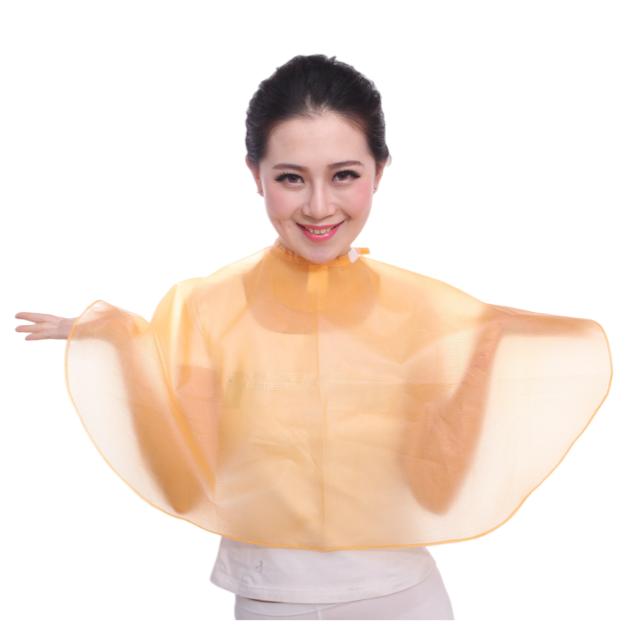
Professionals need reliable tools for heavy chemical processing. PEVA steps in as the ultimate protective shield.
PEVA stands for Polyethylene Vinyl Acetate. It is a non-toxic, eco-friendly vinyl alternative. Manufacturers created it to replace traditional PVC. PEVA lacks the harmful phthalates and chlorine found in older plastics. It delivers the protective benefits of vinyl without the environmental hazards. You get a flexible, smooth surface designed for heavy commercial use.
Absolute Waterproofing: PEVA forms an impenetrable barrier. It completely blocks water, bleach, and hair color. Liquids simply bead up and roll off the surface.
Rapid Turnaround: You can sanitize these covers instantly. Stylists simply spray them with disinfectant and wipe them dry between clients. You require zero laundry downtime.
Eco-Profile: The manufacturing process involves lower toxicity compared to traditional PVC plastics. It releases fewer harmful byproducts into the environment.
No material is flawless. PEVA can feel somewhat stiff or "plastic-like" to clients. It lacks the soft drape of woven fabrics. Furthermore, it offers zero breathability. This can cause heat retention during long chemical processes. Clients might feel warm if they sit under a heavy processing lamp. You must weigh these sensory drawbacks against the protective benefits.
High-end salons often prioritize the sensory experience. Nylon offers a luxurious alternative for everyday styling.
Nylon is a synthetic polymer fabric. The textile industry prizes it for its exceptional strength-to-weight ratio and flexibility. It begins as a lightweight woven cloth. Manufacturers then treat it to handle salon environments. It feels much more like premium apparel than basic protective gear.
Client Experience: It drapes elegantly over the chair and the client. It offers lightweight breathability, keeping clients cool during long visits.
Tear Resistance: The tight polymer weave is highly durable against snags. It resists damage from sharp shears, metal combs, and client jewelry.
Washability: Nylon tolerates standard salon machine washing. You can cycle it through commercial washers and dryers safely.
You must understand the difference between water-resistant and waterproof. Nylon relies on polyurethane (PU) coatings to repel water. The fabric itself will absorb liquids without this layer. Repeated exposure to hot water, harsh detergents, and salon chemicals inevitably degrades this seal. The waterproof coating breaks down over time. Once micro-tears form in the PU layer, the fabric will leak. You must monitor older nylon items closely to prevent surprise stains.
Direct comparisons reveal which material suits specific salon tasks. We evaluate them across three critical operational categories.
Table: Core Material Feature Comparison
Evaluation Criteria | PEVA | Coated Nylon |
|---|---|---|
Waterproof Reliability | 100% impermeable naturally | High initially, degrades over time |
Chemical Resistance | Excellent against heavy bleach | Moderate; bleach accelerates coating failure |
Breathability & Comfort | Low; retains body heat | High; regulates temperature well |
Maintenance Method | Spray and wipe down | Machine wash and tumble dry |
Stain Resistance | High if wiped immediately | Susceptible to staining as it ages |
PEVA wins decisively on absolute impermeability. It serves as an actual physical wall. Heavy color corrections require this level of protection. You cannot risk a bleach drip soaking through to a client's sweater. PEVA handles intense shampooing and double-process coloring flawlessly.
Nylon is highly sufficient for standard cuts and light washes. Fresh PU coatings repel water effectively. However, it poses a distinct risk for heavy chemical work as the fabric ages. You must retire older nylon pieces from the color bar.
PEVA completely eliminates the laundry bottleneck. You use fewer utilities like water and electricity. Because turnaround is instant, you require less total inventory on hand. A busy stylist might only need two or three high-quality Shampoo Capes to get through a fully booked day.
Nylon requires dedicated laundry cycles. You must dedicate staff time to washing, drying, and folding. Consequently, you demand a higher volume of inventory. You need enough clean covers to handle clients while dirty ones sit in the washing machine.
PEVA is highly functional but distinctly utilitarian. It performs a job safely. However, it can stick to bare skin if the client is wearing a sleeveless top. The lack of airflow can feel slightly claustrophobic during a three-hour appointment.
Nylon wins effortlessly on luxury feel. It glides easily over shoulders and salon chairs. It regulates temperature much better. Clients feel like they are wearing a premium garment. It provides a superior tactile experience that aligns with high-end salon branding.
Every salon operates differently. You should base your procurement choices on your most frequent services and physical infrastructure.
Choose PEVA if: Your salon specializes in heavy chemical treatments and color corrections. You should also choose it if you struggle with high laundry turnaround times. Salons prioritizing eco-friendly, PVC-free operational standards benefit greatly from this material.
Choose Nylon if: You run a high-end luxury salon. If client tactile experience is paramount, this is your best option. It is ideal if your primary services are cutting and styling rather than heavy chemical work. You also need a highly efficient laundry infrastructure to manage the volume.
The Hybrid Approach: Many successful salons maintain a 70/30 split. They use PEVA strictly for the color bar and the washbowl. They reserve Nylon for the styling chair. This hybrid method maximizes chemical protection while maintaining luxury comfort during haircuts.
There is no universal winner in the battle between these two materials. The right choice aligns perfectly with your salon's specific service ratio. You must balance chemical processing volume against cutting services. You must also evaluate your internal operational infrastructure realistically.
Your next step is simple. Audit your current replacement rate and laundry volume. Track how many hours your staff spends washing fabrics. Then, request a sample of both PEVA and high-grade coated Nylon. Test them rigorously during a standard busy shift. Observe how liquids react on the surface. Ask your clients for honest feedback on comfort. Once you gather this hands-on data, you can confidently commit to a bulk order that supports your business goals.
A: No. Machine washing can distort or melt the material. They are designed strictly for wipe-down sanitization. You should use a salon-grade disinfectant spray and wipe them dry with a soft cloth.
A: Depending on laundering frequency and detergent harshness, coatings typically begin to degrade between 6 to 12 months of daily commercial use. Once micro-tears form, water will begin to seep through the fabric.
A: Yes. PEVA is hypoallergenic and free of the volatile organic compounds (VOCs) and phthalates commonly associated with older PVC plastics. It is a much safer, non-toxic alternative for sensitive clients.
A: PEVA resists stains more effectively if wiped immediately, as it is non-porous. Light-colored nylon will eventually stain as the protective coating micro-tears, allowing pigments to penetrate the woven fibers.


