


Views: 0 Author: Site Editor Publish Time: 2026-09-18 Origin: Site


Shampoo capes are made from different materials depending on the level of water protection, comfort, durability, washability, and salon application required. Common materials include EVA, nylon, polyester, coated fabrics, and lightweight synthetic blends.
For professional hair salons, the material of a shampoo cape is more than a fabric choice. It affects how easily the cape protects clothing, how comfortable it feels around the neck, how quickly it can be cleaned, and how well it performs during repeated shampoo services.
For salon owners, distributors, and professional hairdressers, understanding the differences between materials makes it easier to select the right professional shampoo capes for specific applications.
Quick Answer: What Are Shampoo Capes Made Of?
Professional shampoo capes are commonly made from:
EVA – waterproof, lightweight, and easy to wipe clean
Nylon – lightweight, flexible, and suitable for coated or treated constructions
Polyester – durable, stable, and available in many fabric constructions
Coated nylon or polyester – designed for enhanced water protection
Synthetic fabric blends – developed to balance comfort, durability, and protection
The best material depends on whether the priority is waterproof performance, comfort, easy cleaning, durability, appearance, or customization.
What Materials Are Shampoo Capes Made Of?
1. EVA Shampoo Capes
EVA, or ethylene-vinyl acetate, is a popular material for waterproof shampoo capes.
Its relatively smooth surface makes it practical for wet salon environments because water and shampoo are less likely to penetrate the material.
Advantages of EVA
Waterproof construction
Easy to wipe clean
Lightweight
Flexible
Suitable for frequent shampoo services
Practical for busy shampoo stations
From a hairstylist's perspective, EVA can be convenient because the cape can be quickly cleaned after a wet service.
From a buyer's perspective, EVA is attractive when water protection and easy maintenance are the main priorities.
EVA vs. Nylon vs. Polyester: Which Material Is Better?
Different materials perform differently in a professional salon.
Material | Water Protection | Comfort | Cleaning | Durability | Best Application |
EVA | ★★★★★ | ★★★★ | ★★★★★ | ★★★★ | Shampoo stations |
Coated Nylon | ★★★★☆ | ★★★★★ | ★★★★ | ★★★★★ | Professional salons |
Polyester | ★★★★☆ | ★★★★☆ | ★★★★ | ★★★★☆ | General salon use |
Lightweight Nylon | ★★★☆☆–★★★★☆ | ★★★★★ | ★★★★ | ★★★★ | Lightweight designs |
Fabric Blend | Depends on finish | ★★★★★ | ★★★★ | ★★★★ | Comfort-focused designs |
Key takeaway: There is no single best shampoo cape material for every salon. EVA is particularly suitable when waterproof protection is the priority, while coated nylon or polyester can provide a balance between protection, flexibility, comfort, and appearance.
Are Nylon Shampoo Capes Good for Professional Salons?
Nylon is widely used in salon apparel because it is lightweight, flexible, and relatively easy to handle.
When nylon is combined with an appropriate coating or water-repellent treatment, it can provide additional protection during wet services.
Why Hairdressers May Prefer Nylon
From a stylist's perspective, a lightweight nylon cape can be easier to:
Put on and remove
Fold and store
Handle around the shampoo basin
Adjust around the client's neck
Use repeatedly during a busy workday
Nylon can also provide a more textile-like appearance than some plastic-based materials.
For buyers looking for branded salon shampoo capes, nylon offers additional opportunities for custom colors, sizes, prints, and other design specifications.
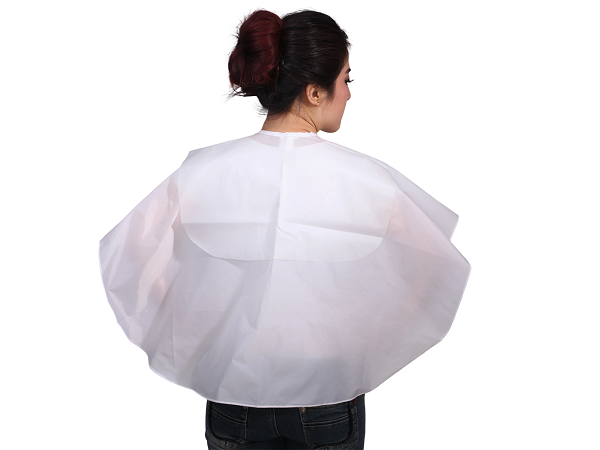
What About Polyester Shampoo Capes?
Polyester is another common synthetic material used for salon apparel.
It can provide good durability, dimensional stability, and consistent appearance. Depending on the fabric structure and finishing process, polyester can also be developed for water-resistant or stain-resistant applications.
Polyester Is a Good Choice When:
Durability is important
The salon needs consistent appearance
The cape will be washed frequently
Custom printing is required
The buyer needs multiple color options
For distributors and salon groups, polyester can be a practical material for products designed for repeated professional use.
Waterproof vs. Water-Repellent Shampoo Capes
One important distinction for professional buyers is the difference between waterproof and water-repellent.
Waterproof Shampoo Capes
A waterproof construction is designed to provide a stronger barrier against liquid penetration.
This is especially useful at shampoo stations where water exposure is frequent.
Water-Repellent Shampoo Capes
A water-repellent finish causes water to bead or run off the surface more easily, but it does not necessarily mean the material is completely waterproof.
Therefore, buyers should not evaluate a cape only by the phrase "water-resistant." The actual fabric construction, coating, and finishing process should also be considered.
Shampoo Capes with Velcro Closure vs. Snaps Closure
Material is only one part of the buying decision. The neck closure also affects daily salon performance.
Shampoo Capes with Velcro Closure
Shampoo capes with Velcro closure are designed for fast and adjustable fitting.
Advantages
Quick to put on
Easy to adjust
Suitable for different neck sizes
Convenient during high-volume services
Simple for stylists to operate
For a busy shampoo station, Velcro can save time when clients arrive one after another.
Shampoo Capes with Snaps Closure
Shampoo capes with snaps closure provide fixed adjustment positions and a traditional professional appearance.
Advantages
Durable fastening
Multiple adjustment positions
Clean appearance
Suitable for repeated use
Easy to standardize for salon operations
Velcro vs. Snaps Comparison
Feature | Velcro | Snaps |
Adjustment speed | Excellent | Good |
Neck adjustment | Very flexible | Fixed positions |
High-volume use | Excellent | Excellent |
Closure durability | Good | Excellent |
Easy operation | Excellent | Good |
Best for | Fast service | Long-term repeated use |
Stylist's choice: Choose Velcro when speed and adjustment are priorities. Choose snaps when closure durability and fixed adjustment positions are more important.
Which Shampoo Cape Material Is Best for Different Salon Scenarios?
The best material changes according to the actual working environment.
Scenario 1: High-Volume Hair Salon
A busy salon may shampoo dozens of clients per day.
The ideal cape should prioritize:
Waterproof protection
Fast cleaning
Easy handling
Durable closure
Repeated-use performance
EVA or coated synthetic fabrics can be suitable choices.
Scenario 2: Premium Hair Salon
A premium salon may place greater emphasis on:
Soft hand feel
Lightweight construction
Professional appearance
Comfortable neck fit
Consistent branding
A lightweight nylon or polyester construction may provide a better balance.
Scenario 3: Children's Hair Services
Shampoo capes for kids need to consider both protection and comfort.
A children's shampoo cape should ideally provide:
Appropriate sizing
Comfortable neck adjustment
Lightweight construction
Easy cleaning
Sufficient coverage
For children's services, buyers should pay particular attention to material composition, finishing, closure design, and age-appropriate dimensions.
Scenario 4: Salon Chain
A salon chain may need hundreds or thousands of capes with consistent specifications.
In this case, custom shampoo capes can be developed according to:
Custom color
Custom size
Fabric selection
Closure type
Printed patterns
Embroidered or printed logos
Packaging requirements
Consistency between production batches becomes especially important for multi-location businesses.
Material Selection Matrix for Professional Shampoo Capes
The following matrix provides a quick purchasing reference.
Buyer Priority | Recommended Material | Recommended Design |
Maximum water protection | EVA | Waterproof construction |
Lightweight comfort | Nylon | Lightweight/coated nylon |
Durable daily use | Polyester/Nylon | Reinforced construction |
Easy cleaning | EVA/Coated Fabric | Smooth protective surface |
Premium appearance | Nylon/Polyester | Refined textile finish |
Children's services | Lightweight synthetic | Comfortable adjustable closure |
High-frequency salon use | EVA/Coated Fabric | Durable closure |
Custom branding | Nylon/Polyester | Custom color/print |
Wholesale programs | Polyester/Nylon/EVA | Standardized specification |
This approach allows buyers to choose according to the actual salon environment rather than simply selecting the cheapest material.
What Should Hairdressers Look for in a Shampoo Cape?
From a hairstylist's perspective, a shampoo cape should solve practical problems during the working day.
1. Does It Keep Water Off the Client?
The primary function is protecting clothing and skin from water and shampoo.
2. Is It Comfortable Around the Neck?
A cape that feels too tight, rough, heavy, or restrictive can negatively affect the client experience.
3. Is It Easy to Put On?
Fast application is particularly important in busy salons.
4. Can It Be Cleaned Quickly?
The surface should be appropriate for the salon's cleaning routine.
5. Does It Provide Enough Coverage?
The cape should work with the shampoo basin and the client's body size.
What Should Buyers Look for When Purchasing Shampoo Capes?
From a purchasing manager's perspective, the evaluation process is broader.
Consider:
Material composition
Waterproof or water-repellent performance
Fabric weight
Size
Neck closure
Stitching quality
Washability
Color consistency
Customization options
MOQ
Packaging
Production capacity
Quality control
OEM/private-label capability
For shampoo capes wholesale, the lowest unit price is not necessarily the lowest total cost. A durable cape that survives repeated salon use can provide better long-term purchasing value.
What Size Shampoo Cape Should You Choose?
Size affects both protection and client comfort.
Example Size | Approx. Inches | Suitable Application |
90 × 80 cm | 35 × 31.5 in | Compact shampoo services |
110 × 113 cm | 43.25 × 44.5 in | General salon services |
110 × 127 cm | 43.25 × 50 in | Extended coverage |
Custom | Custom | Salon chains/OEM |
For short hair shampoo services, a compact cape may be sufficient. Longer hair, frequent rinsing, and extended treatments may benefit from greater coverage.
For shampoo capes for kids, adult dimensions should not simply be reduced proportionally. The neck opening, body coverage, weight, and closure should be designed around children's actual proportions and comfort.
Why Are Washable Shampoo Capes Important?
Washable shampoo capes are valuable in professional salons because shampoo services are repeated throughout the day.
Regular cleaning helps remove:
Shampoo residue
Conditioner
Hair products
Skin oils
Water stains
General salon debris
The appropriate cleaning method depends on the material. EVA and coated surfaces may be easy to wipe, while textile-based capes may require machine or hand washing according to the manufacturer's instructions.
A professional maintenance routine should follow:
Remove residue → Clean → Wash when required → Dry completely → Inspect → Store.
Custom Shampoo Capes: What Can Buyers Customize?
For distributors, salon groups, and private-label brands, custom shampoo capes provide greater control over product appearance and functionality.
Depending on the manufacturer's capabilities, buyers may customize:
Fabric
Material thickness
Dimensions
Neck closure
Color
Print pattern
Logo
Label
Packaging
A customized product can help salon chains maintain a consistent visual identity across multiple locations.
FAQ: What Are Shampoo Capes Made Of?
What is the most common material for shampoo capes?
Common materials include EVA, nylon, polyester, coated nylon, and other synthetic fabric constructions. EVA is particularly suitable for waterproof applications, while nylon and polyester offer more flexibility in comfort, appearance, and customization.
Are EVA shampoo capes better than fabric shampoo capes?
Not necessarily. EVA can be better for maximum waterproof protection and easy cleaning. Fabric-based capes may be preferable when comfort, flexibility, appearance, or branding is more important.
Are nylon shampoo capes waterproof?
Nylon itself is not automatically waterproof. Waterproof performance depends on the fabric construction, coating, membrane, or finishing treatment used by the manufacturer.
Are polyester shampoo capes washable?
Many polyester shampoo capes can be washed, but the exact care instructions depend on the fabric construction and any coating or treatment applied.
Are shampoo capes with Velcro closure better than snaps?
Neither is universally better. Shampoo capes with Velcro closure are convenient when fast and flexible adjustment is needed, while shampoo capes with snaps closure are a strong choice for durable, fixed adjustment.
What are shampoo capes for kids made of?
Shampoo capes for kids can be made from lightweight polyester, nylon, EVA, or other suitable synthetic materials. The most important factors are appropriate sizing, comfort, protection, easy cleaning, and safe, practical closure design.
Can I order custom shampoo capes?
Yes. Custom shampoo capes can be produced with customized materials, sizes, colors, closures, prints, logos, and packaging depending on the manufacturer's capabilities and MOQ.
Final Buying Guide: Which Shampoo Cape Material Should You Choose?
Choosing the right material starts with the actual service environment.
Choose EVA when:
You need strong waterproof protection and easy cleaning.
Choose coated nylon when:
You want lightweight comfort combined with enhanced water protection.
Choose polyester when:
Durability, appearance, and consistent production are important.
Choose customized construction when:
You are a salon chain, distributor, importer, or private-label buyer with specific requirements.
For professional hairdressers, the ideal shampoo cape should be comfortable, protective, easy to handle, and easy to maintain. For buyers, the ideal product should also provide reliable quality, consistent production, suitable customization, and competitive long-term value.
Ultimately, the best professional shampoo capes are selected by matching material + water protection + size + closure + application + maintenance requirements rather than choosing a material based on price alone.


