


Views: 0 Author: Site Editor Publish Time: 2026-10-17 Origin: Site


Every barber knows the daily physical toll of working behind the chair. You face relentless hair splinters, accidental chemical spills, and the constant struggle against overheating. These challenges make choosing the right gear essential for your daily comfort. We constantly see a core debate among shop owners. Do you prioritize the unrestricted mobility of vests, or do you need the complete coverage of jackets? Navigating this choice dictates how your team operates and feels throughout a demanding shift.
This guide provides an objective framework for making that decision. We will help you choose between barber jackets and vests based on your shop climate, service types, and unique brand identity. You will learn the hidden trade-offs of each garment type. We will also help you align your uniform choices with your daily operational needs. Read on to discover how upgrading your apparel can minimize fatigue, improve shop hygiene, and elevate your professional image.
Jackets offer maximum protection against hair splinters and chemical stains but require highly breathable fabrics to prevent overheating.
Vests maximize arm mobility and climate comfort but leave forearms exposed during heavy clipping sessions.
The choice directly impacts daily hygiene, stylist fatigue, and the perceived premium value of the barbershop.
Blended approaches (e.g., vests for summer/clippers, jackets for winter/chemicals) often yield the highest staff adoption rates.
Your workwear serves as the silent ambassador of your brand. Client perception heavily relies on visual cues the moment they walk through your doors. Standardized uniform choices instantly signal strict hygiene protocols and professionalism. They also communicate your shop tier. A traditional, high-end grooming lounge often benefits from classic apparel. Meanwhile, an urban fade shop might prefer an agile, streetwear-inspired look. Clients notice these details. When you invest in premium stylist workwear for barbershops, you elevate the entire customer experience.
Beyond aesthetics, you must consider the operational reality behind the chair. Personal clothing simply cannot withstand the rigors of professional barbering. Stray hairs weave into regular cotton t-shirts. Bleach drops permanently ruin expensive streetwear. The financial cost of replacing ruined personal clothing quickly outpaces the initial investment in durable workwear. High-quality garments act as a necessary shield. They protect your personal wardrobe while presenting a unified team front.
Defining success for your uniform purchase requires strict criteria. A successful garment must survive over 100 high-temperature industrial wash cycles without fraying. It must maintain zero-static properties over its lifespan so hair effortlessly slides off. Furthermore, you need zero staff complaints about restricted movement. If a garment looks great but hinders a barber's ability to execute a complex fade, it fails the operational test. Balancing these elements forms the foundation of a smart uniform strategy.
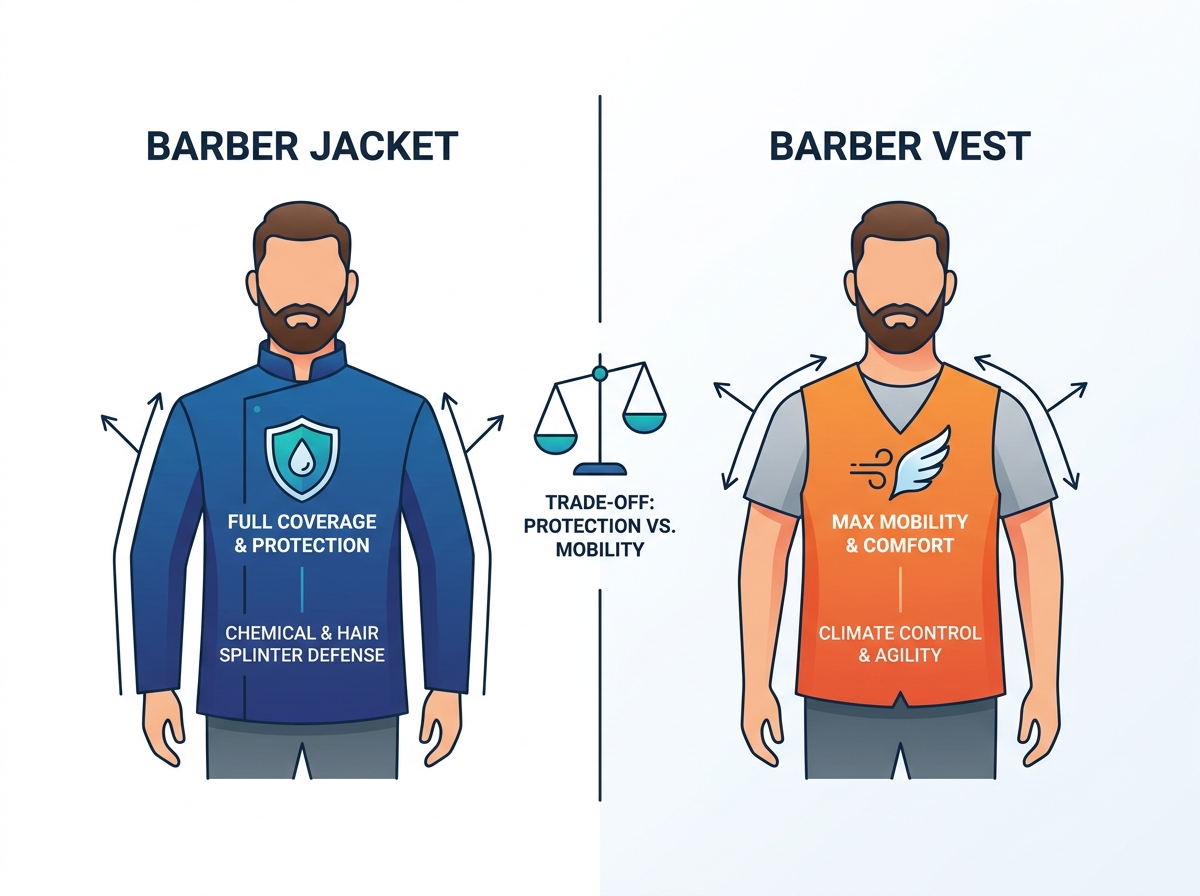
For barbers seeking maximum coverage, nothing beats a well-constructed jacket. The core advantage lies in comprehensive bodily protection. Barbers face microscopic hair splinters daily. These tiny fragments easily penetrate standard fabrics, causing painful skin irritation known as barber's rash. Jackets provide a vital barrier. They shield your torso and arms completely. They also offer unmatched protection against accidental color splashes and bleach drops during chemical services. When you wear professional barber jackets, you eliminate the anxiety of ruining the clothes underneath.
From an aesthetic standpoint, jackets project a classic and clinical image. They carry a sense of traditional authority. Clients often associate this look with high-end grooming lounges and master barbers. A crisp jacket tells the client they are in expert hands. It creates a neat, uniform silhouette across your entire staff. This visual consistency builds immediate trust. It shows you take your craft seriously.
However, we must view jackets through a skeptical lens. They come with distinct trade-offs.
Heat Retention: Jackets pose a high risk of overheating. Peak hours in poorly ventilated shops will make you sweat heavily.
Mobility Restrictions: Incorrect fits cause annoying sleeve friction. This minor drag can hinder your precision during complex shear work.
Sleeve Contamination: Long sleeves occasionally brush against a client's wet hair or shaving cream if not tailored properly.
Given these factors, jackets suit specific scenarios best. They are ideal for chemical specialists who need bleach protection. They work wonderfully for traditional barbers performing hot towel shaves. They also excel in cooler shop environments where extra layers provide comfort rather than heat exhaustion.
If jackets represent complete protection, vests represent ultimate agility. The core advantage of a vest is complete freedom of movement. Your shoulders and elbows experience zero restriction. You never deal with sleeve drag when reaching for clippers or stretching to perfect a fade. This unrestricted mobility reduces physical fatigue during a grueling ten-hour shift. Barbers who utilize rapid clipper movements often prefer this unhindered feel.
Temperature control serves as another massive advantage. Vests offer superior ventilation naturally. Here are three reasons why they excel in climate control:
Core Layering: You can easily layer a vest over personal streetwear or thin t-shirts without sweating out.
Air Circulation: Exposed arms allow body heat to escape faster, keeping your core temperature stable.
Seasonal Adaptability: You can wear short sleeves in summer and swap to long sleeves in winter while keeping the same vest.
Despite these benefits, vests carry their own set of trade-offs. The most glaring issue is exposure. Vests leave your forearms completely unprotected. You will face a barrage of hair splinters. Localized skin irritation becomes a frequent problem during heavy clipping sessions. Additionally, vests can sometimes look overly casual. If your shop lacks a strict dress code for the underlying clothing, a mismatched t-shirt can ruin the professional aesthetic.
Vests shine in fast-paced environments. They are best for high-volume fade specialists. They fit perfectly in warm climates where heavy layers are unbearable. They also align beautifully with modern, streetwear-influenced shop aesthetics, where barbers want to showcase their personal style underneath.
Choosing between these two garment styles requires careful analysis of specific features. You cannot rely on style alone. You must evaluate the technical specifications of the apparel.
Workwear Evaluation Matrix
Feature | Barber Jackets | Barber Vests |
|---|---|---|
Arm Mobility | Moderate (depends on tailoring) | Maximum |
Hair Splinter Protection | High (Full arm coverage) | Low (Forearms exposed) |
Temperature Regulation | Requires vented panels | Naturally breathable |
Chemical Protection | Excellent | Poor for arms |
The material of your workwear dictates its daily performance. Always evaluate nylon versus poly-blends. Nylon typically offers better durability and a lighter feel. Poly-blends sometimes mimic cotton but dry much faster. Mandatory features include anti-static properties. Hair must slide off the garment instantly. If hair sticks, the garment fails. Additionally, the fabric must be highly water-resistant and bleach-proof. Accidental spills happen daily. Your gear must repel liquids before they soak through to your skin.
Heat fatigue slows you down and affects your mood. Jackets require specific design elements to combat this. Look for mesh back panels or vented armpits. These hidden features allow trapped heat to escape rapidly. Vests naturally excel at temperature regulation due to the lack of sleeves. However, they still require moisture-wicking inner linings. A heavy, unlined canvas vest will trap sweat against your back just as badly as a poorly made jacket.
Your garment acts as a wearable tool belt. Pocket placement matters immensely. Bottom pockets work best for storing larger clips and combs. Chest pockets safely hold smaller shears or razors. We must issue a strict warning here. Avoid overly deep pockets. Deep, baggy pockets act as traps for falling hair and debris. Digging past a layer of itchy hair to grab your comb is unsanitary and frustrating. Look for shallow, easy-clean pocket designs.
Shop owners must think about scalability. You want your team to look cohesive. Evaluate the ease of customization for both garment types. Both styles should support embroidered shop logos on the left chest. They should also accommodate customized name tags. Jackets often offer more real estate on the back for large, bold logo placements. Ensure the fabric you choose can handle heavy embroidery stitching without puckering or tearing.
Mandating new uniforms across a whole team often brings unexpected challenges. You must anticipate implementation risks to ensure a smooth transition. Staff adoption friction is the most common hurdle. Forcing heavy jackets on a team accustomed to lightweight vests will spark immediate complaints. Barbers will cite excessive heat and restricted movement. To mitigate this, involve your senior staff in the selection process. Let them handle the fabrics before you commit to a bulk purchase.
Sizing inconsistencies present another major operational headache. Vests generally offer a more forgiving fit. A slightly loose vest still functions perfectly well. Jackets require precise shoulder and sleeve measurements. If a jacket runs too large, the barber looks sloppy. If it runs too small, they cannot lift their arms to cut hair. You must gather accurate measurements for every team member to prevent expensive returns.
Finally, understand the maintenance realities. Professional workwear requires daily washing to maintain hygiene standards. The hardware on these garments must withstand extreme abuse. Zippers and snap buttons must be heavy-duty. Cheap plastic zippers warp and melt during industrial wash cycles. Weak snaps lose their grip after a few weeks of constant pulling. Invest in high-quality hardware to extend the lifespan of your uniform.
Your final decision rests on your specific operational priorities. There is no universally perfect answer. Instead, there is a perfect answer for your specific business model.
If you choose jackets, prioritize lightweight, vented models. Insist on flexible armholes to guarantee mobility. Avoid thick, unlined canvas materials. If you choose vests, you must implement a strict "under-shirt" dress code. Establish a professional baseline. Mandate solid colors or specific sleeve lengths to prevent the shop from looking uncoordinated.
Many successful shops adopt a hybrid approach. They purchase both items. They assign jackets for messy chemical and color services. They then assign vests for dry cuts and heavy clipper work. This gives barbers the flexibility they crave while maintaining shop standards.
Your next steps are straightforward. Do not guess on a bulk order. Order a single sample of each garment type. Have your busiest barber test them during a grueling 10-hour shift. Gather their honest feedback on heat, mobility, and pocket placement before executing your final team order.
Choosing the right professional apparel goes far beyond simple aesthetics. The best choice fundamentally balances your barber's daily physical comfort with your shop's established brand identity. Jackets provide necessary armor against splinters and chemicals, establishing a classic authority. Vests offer unbeatable agility and climate control for high-speed fading.
Take time to audit your daily operations. Analyze your shop's temperature and your team's most frequent services. Check sizing guides carefully and review fabric specifications for anti-static properties. Take action today by requesting a customized embroidery quote for your shortlisted option. Upgrading your gear is a direct investment in your team's longevity and your shop's success.
A: Jackets generally trap more heat due to full arm coverage. However, fabric weight matters more than style. A lightweight nylon jacket with mesh vents often feels cooler than a thick, heavy canvas vest without a moisture-wicking lining.
A: Wash your gear in cold or warm water using standard detergent. You must strictly avoid fabric softeners. Softeners leave a chemical residue that ruins both water-resistant coatings and anti-static properties, causing hair to stick to the garment.
A: Yes. Both garments support custom embroidery. Vests usually feature logos on the left chest due to limited back space. Jackets offer large, flat back panels, making them perfect for displaying full-sized, intricate shop logos.
A: If you wear a vest, you leave your forearms exposed. To avoid splinters, wear a tight-fitting, breathable long-sleeve undershirt. Alternatively, apply an invisible liquid barrier cream to your forearms before your shift to block microscopic hair fragments.


